To depose a director of nursing, get one thing: the DON is the person who can say what the facility’s policies required and whether anyone enforced them. Your goal is to tie each entry, gap and late note in the chart to a written requirement that the DON has to acknowledge.
On screen: Title card, “How to Depose a Director of Nursing.” Below it, the sequence: Role, Policies, Chart, Staffing, Supervision.
Spoken: The order matters more than any single question. If you show the chart first, the DON can call each gap an individual lapse by one nurse on one shift. If you establish the policy first, the same gap becomes a departure from a standard the facility set for itself.
Who is the DON, and what do they actually own?
The DON is usually the senior nursing leader in a facility, but the exact duties differ from one facility to the next. Treat everything below as an area to confirm in testimony, not a fact to assume in your questions.
On screen: Four labels appear one at a time: Care policies, Staffing, Supervision, Nurse training.
Spoken: Before you ask about this resident, find out what this DON is responsible for. Four areas tend to matter in a nursing home neglect case:
- Care policies. Who drafts, approves, revises and retires the facility’s nursing policies and procedures?
- Staffing. Who sets the schedule, approves agency or overtime coverage, and decides how many nurses and aides work a unit?
- Supervision. Who reviews nurses’ work, charting and care plans, and how often?
- Nurse training. Who decides what orientation and ongoing education staff receive, and who tracks whether it happened?
Ask these as open questions and let the DON describe the job in their own words. A DON who says they own policy and staffing has just taken responsibility for the areas your case turns on. A DON who says someone else owns them has given you the next name to subpoena.
A few short foundation questions fit here:
- How long have you been the Director of Nursing at this facility?
- Who do you report to, and who reports to you?
- Which units and which shifts fall under your responsibility?
- Were you in the role on every date at issue in this case?
- What documents did you review to prepare for today?
That last question is worth a pause. The answer tells you what the DON has read, what they have not, and what you may want to request before the deposition continues.
How do you pin down the policies first?
Get the written policy on the record before you show the DON a single chart entry. Ask for it, ask who wrote it, and ask who must follow it.

On screen: A policy document fills the frame with three highlighted fields: Title and version, Effective date, Who it applies to.
Spoken: Pick the policies that match the harm alleged. For a fall, that could be fall prevention and reassessment. For a pressure injury, it could be skin assessment and repositioning. For medication problems, it could be administration and documentation. Then walk through each one in the same pattern.
- Is this the policy that was in effect on the dates at issue?
- Who wrote it, and who approved it?
- Who is required to follow it? Nurses, aides, agency staff?
- Is it written to be followed as stated, or as a loose guideline?
- How are staff told about it, and how do you confirm they understand it?
- What happens when a staff member does not follow it?
The fifth and sixth questions get less attention than they deserve. A policy that exists on paper but has no training, no check and no consequence tells a very different story than one that is taught and audited.
Close each policy with a plain commitment. “As the Director of Nursing, you expected your nurses to follow this policy, correct?” Get the yes before you move on. You will come back to it.
If the DON says a policy is outdated or was replaced, ask for the earlier and later versions and the dates of each change. Revision history can matter as much as the policy itself, and your requests for production should already ask for it.
Training is part of this area too. Staff cannot follow a policy nobody taught them, and a DON who owns education has to explain what was taught. For background on the education side, see the nursing CEU platforms attorneys should know before deposing a nurse.
How do you connect the policy to this resident’s chart?
Walk the DON from the requirement to the specific entries, one policy at a time. Now the chart comes out, because the DON has already agreed what the standard was.
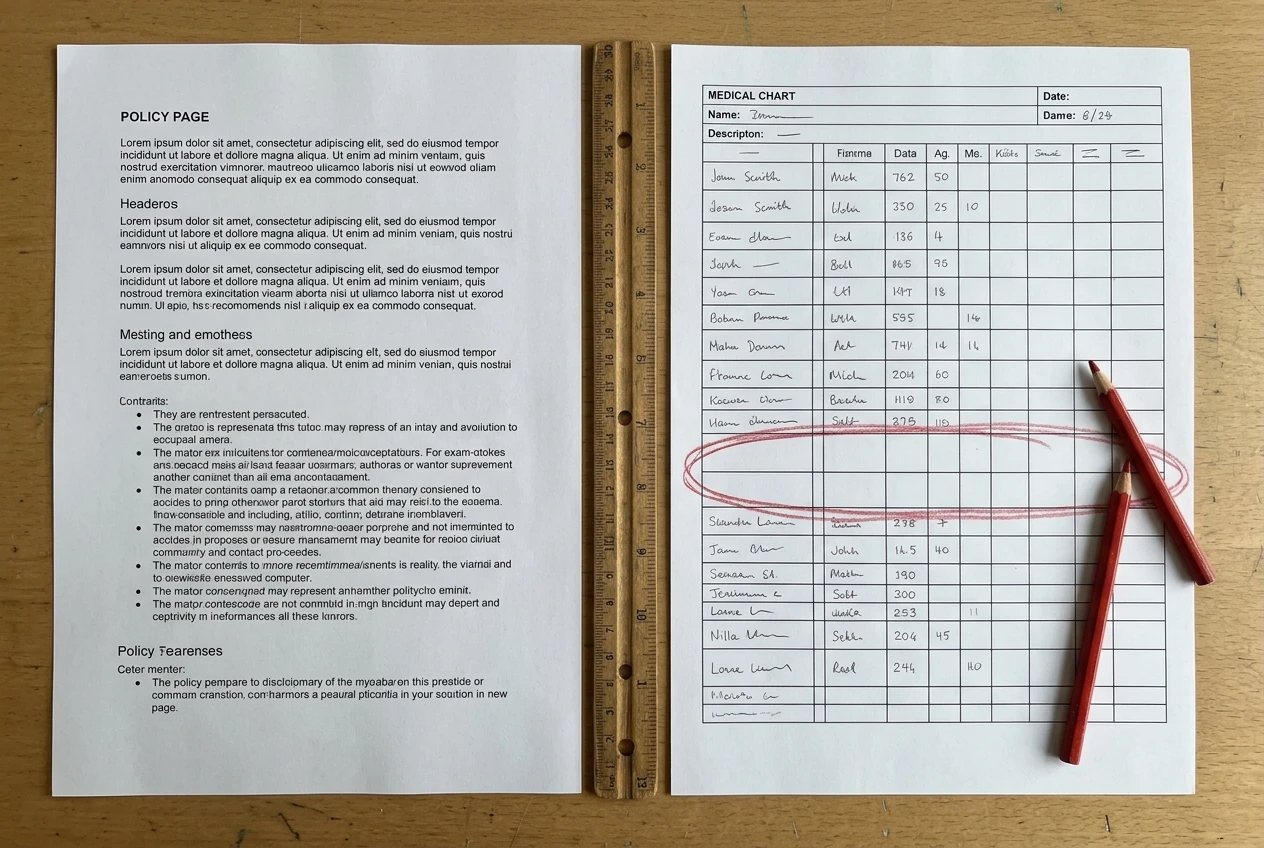
On screen: Split screen. Left: the policy sentence. Right: the matching chart page, with the missing or late entry circled.
Spoken: Use a repeating structure. Read the requirement, ask the DON to confirm it, then show the entry and ask what the chart shows.
- “The policy requires reassessment after a change in condition. Where in this chart is that reassessment?”
- “The policy requires documentation at the time of care. This entry is timed several hours after the shift began. Is that consistent with the policy?”
- “This section is blank for these dates. Does a blank mean the care was given and not recorded, or not given? How would you know?”
That last question is the most useful one in this section. The DON has two answers available. If the care was given but not documented, the facility’s own record does not support it. If the care was not given, the policy was not met. Either answer helps you, so ask it plainly and wait.
Two exhibits do much of the work here:
- Staffing logs. They show who was on duty when a required task should have happened. If you need a method for reading them, see how to read a nursing home staffing log for ratios that show neglect.
- The medication administration record. It shows what was ordered, what was signed off and where entries are missing. For patterns across weeks, see how to read a medication administration record for patterns of systemic neglect.
Mark each exhibit before the deposition and keep a one-page index of which policy line each chart entry answers. Moving between a policy, a log and a record while a witness waits is slow, and a prepared index keeps your questioning continuous.
Resist the urge to argue with the witness about what a clinical entry means. Ask what the facility’s own policy says it should mean. The DON’s reading of the facility’s documents carries more weight at trial than your reading of them.
What do you ask about staffing and supervision?
Ask about staffing ratios on the dates at issue, who covered each shift, who reviewed the charting, and what the DON knew and when. These four lines of questioning tie the missing care to decisions the DON owns.

On screen: A calendar with the dates at issue highlighted, and a list of four prompts: Ratios, Coverage, Review, Knowledge.
Spoken: Start with the numbers, because they are the hardest to explain away.
Ratios and coverage
- On these dates, how many nurses and aides were assigned to this resident’s unit on each shift?
- Is that the number the facility planned for, or the number that showed up?
- Were there call-outs, vacancies or agency staff on those shifts?
- Who approved the schedule, and who could have approved additional coverage?
- Did any assignment exceed what the facility considered safe?
Do not assume the answers. Some facilities staff to a written plan, some to a census formula, some case by case. Let the DON describe it and tie your follow-up to what they say.
Supervision and review
- Who was the supervising nurse on each shift at issue?
- Who reviewed nursing documentation for completeness, and how often?
- Were incomplete or late entries flagged, and where is that recorded?
- Did you or anyone on your team review this resident’s care plan after the change in condition?
Knowledge and notice
- Before this incident, were you aware of staffing shortages on this unit?
- Were concerns raised to you by staff, families or surveyors, and how were they recorded?
- What did you do in response, and when?
- Was there any report, meeting note or email that mentions these issues?
The knowledge questions establish notice. A DON who knew about coverage problems and left them in place is a different witness from one who learned about them after the incident. Ask for dates, documents and names every time, so the answers can be checked against what you have requested.
Keep tone steady throughout. Short, factual questions produce clean transcript lines. Long, loaded questions produce objections and speeches.
What should you do before the deposition starts?
Have a nurse consultant review the chart and the policies with you and help you build your question outline before the deposition is scheduled.
On screen: A checklist: Chart reviewed, Policies matched to entries, Staffing dates flagged, Question outline built. A link appears to the article on what a nurse consultant does in the room during a deposition.

Spoken: A nurse reads a chart differently than a lawyer does. A consultant can tell you which blank fields matter clinically, which late entries are routine for the setting, and which policy lines the care should have followed. That turns a stack of records into a sequence of questions that follows the order above: role, policies, chart, staffing, supervision.
A practical preparation list:
- Gather the policies in effect on the dates at issue, with their revision histories.
- Pull the staffing logs and the medication administration record for the same dates.
- Have the consultant mark every entry that should connect to a policy requirement.
- Draft the question outline in the order shown in this script.
- Decide which exhibits to mark, and build the one-page index.
The aim is a deposition in which every chart exhibit you show has a policy question already on the record behind it.
Before you notice the Director of Nursing’s name on a deposition notice, have a nurse consultant review the chart and policies with you. Read what a nurse consultant does in the room during a deposition.