
Pressure ulcer litigation often turns on a single question: was this stage assigned correctly, and does the progression documented in the chart match what actually happened to the tissue? Attorneys who can follow the clinical reasoning behind a staging opinion, rather than just trusting the expert’s conclusion, are better positioned to prepare for deposition, cross-examine opposing experts, and recognize when a case needs a different kind of review. This piece walks through how a nurse expert evaluates pressure ulcer staging in medical records for causation and avoidability, not just for documentation accuracy.
What NPIAP Staging Categories Actually Measure
The National Pressure Injury Advisory Panel staging system classifies pressure injuries by the depth of tissue damage visible at the time of assessment, not by how long the wound has existed or how it will progress. A Stage 1 injury shows intact skin with non-blanchable redness. Stage 2 involves partial-thickness skin loss with exposed dermis. Stage 3 reaches full-thickness skin loss where subcutaneous fat may be visible. Stage 4 exposes fascia, muscle, tendon, ligament, cartilage, or bone.

Two categories sit outside this depth ladder. An unstageable pressure injury is one where slough or eschar covers the wound bed enough that the true depth cannot be determined. A deep tissue pressure injury presents as a persistent area of discoloration, often purple or maroon, that signals damage occurring below the surface before the skin itself breaks down.
The distinction attorneys need to hold onto is that staging describes a snapshot of tissue depth, not a narrative of cause. A Stage 4 wound tells you how deep the damage goes. It does not, by itself, tell you whether the facility caused it, whether it was preventable, or how long it took to get there. Those are separate questions that require separate evidence, and a staging opinion that conflates the two is usually weaker than it looks on paper.
Why a Pressure Injury Can Never Be Reverse Staged
One of the clearest markers of a chart that was not reviewed correctly, or of a facility’s documentation that misunderstands wound biology, is reverse staging. This happens when a nurse or provider documents a wound as “healing” by moving it backward through the stages, for example charting a Stage 4 wound as a Stage 3, then a Stage 2, as granulation tissue fills in.
NPIAP guidance is explicit that this is clinically incorrect. Once a pressure injury has reached full-thickness tissue loss, the body does not replace lost muscle, fat, or dermis with the same tissue types. It fills the defect with granulation tissue, a different kind of tissue entirely. A healing Stage 4 wound remains a healing Stage 4 wound until it closes completely. It is never correctly restaged as a Stage 3 or Stage 2 along the way.
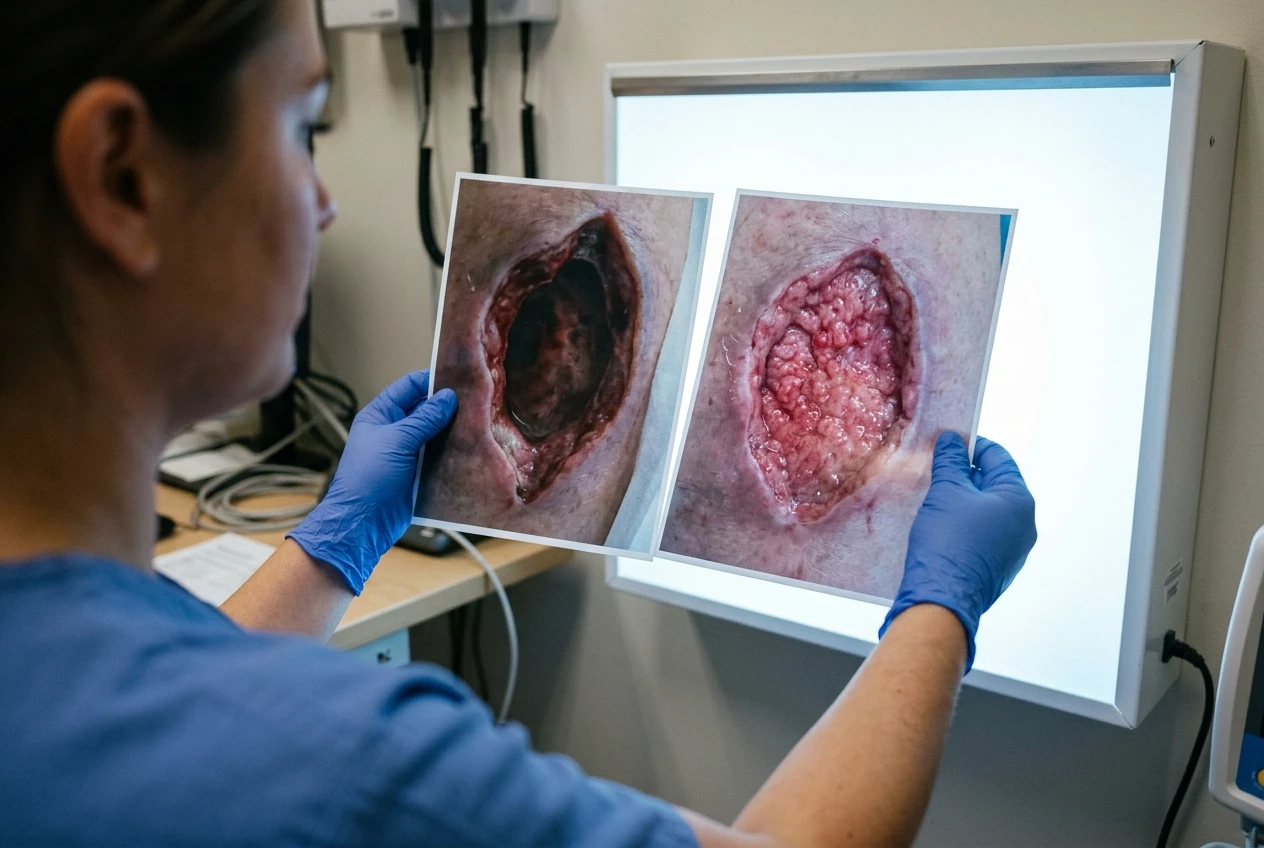
When a chart shows reverse staging, it usually means one of two things. Either the staff documenting the wound did not understand staging rules, which raises questions about training and competency, or the facility was trying to make the wound’s trajectory look better than it was, which raises questions about intent. Either explanation matters to a negligence case, and an expert who catches this pattern early can build it into both the standard-of-care analysis and the credibility assessment of the nursing staff who charted it.
Reconstructing the Wound Timeline Across Shifts and Providers
Pressure injuries develop and progress over time, and nursing home and hospital records are rarely written by one consistent observer. Wound assessments pass between day shift, night shift, weekend staff, wound care nurses, and sometimes outside specialists who see the patient only once. Reconstructing an accurate timeline means pulling every wound-related entry across all of these sources and lining them up chronologically, not just reading the wound care flowsheet in isolation.

This matters because staging language often shifts not because the wound changed but because the person charting it changed. One nurse may measure and stage conservatively. Another may use different terminology for the same presentation. A timeline built only from the flowsheet can miss a nursing note three days earlier that first mentions redness over a bony prominence, or a physician’s progress note that describes a wound in terms inconsistent with what the flowsheet says.
A careful reconstruction pulls from:
- Admission skin assessments and the baseline Braden or Norton score
- Shift-to-shift nursing notes, not just the dedicated wound flowsheet
- Wound care specialist or physician consult notes
- Turning and repositioning records
- Nutrition and hydration documentation
- Any transfer or discharge summaries that describe skin condition
Once these are aligned by date and time, gaps become visible. A wound that is “Stage 2” on Monday and suddenly “unstageable” on Thursday with no interim assessment is a gap that needs explaining. So is a multi-day stretch with no skin assessment at all during a period when the patient was known to be at high risk. These gaps are often where the causation story actually lives.
Separating Avoidable Progression From Unavoidable Decline
Not every pressure injury that worsens reflects a failure of care. Patients with severe circulatory disease, certain end-of-life conditions, or extreme malnutrition can develop and progress wounds despite appropriate interventions. The clinical and legal standard for avoidability asks whether the facility assessed the patient’s risk, implemented interventions consistent with that risk level, monitored for effectiveness, and adjusted the care plan when the wound did not improve.

Evaluating avoidability means looking past the stage itself and into the care plan that surrounded it. Relevant questions include:
- Was a risk assessment tool used on admission and at appropriate intervals afterward?
- Did the documented interventions match the assessed risk level, such as pressure-redistributing surfaces, repositioning schedules, and nutritional support?
- Were repositioning and turning actually documented as performed, not just ordered?
- When the wound did not respond to the initial plan, was the plan reassessed and changed?
- Does the medical record show a clinical explanation, such as refusal of care, severe comorbidity, or a documented end-of-life trajectory, that would support unavoidability?
A wound that progressed despite a well-documented, appropriately escalated care plan looks very different from a wound that progressed through silence in the record. The staging evaluation and the avoidability evaluation have to run side by side, because a defense expert will often argue unavoidability regardless of what the stage itself shows, and that argument has to be tested against the actual interventions charted, not just asserted against the diagnosis.
Where Staging Evaluation Overlaps With Documentation Errors
Staging evaluation and documentation error review are related but not identical tasks. Documentation errors are the specific red flags in a chart, things like missing measurements, inconsistent stage terminology between providers, or wound descriptions that do not match the stage assigned. A separate piece on this site, how to catch pressure ulcer staging errors in nursing home records, walks through those red flags in detail.
The clinical evaluation framework described here sits one level up. It asks what those errors mean once they’re found. A single mismeasured wound might be a clerical mistake. A pattern of reverse staging, missing assessments during high-risk periods, and interventions that never escalate as the wound worsens tells a different story: one where the documentation errors are symptoms of a broader standard-of-care failure rather than isolated clerical slips.
Attorneys get the most value from using both lenses together. The documentation review identifies what’s wrong with individual entries. The clinical evaluation framework explains whether those errors, taken as a whole, support a theory of causation and avoidability that will hold up under cross-examination.
Building a Defensible Causation Opinion From the Chart
A causation opinion in a pressure injury case needs to connect three things: the timeline of when the wound appeared and progressed, the care that was or was not provided during that window, and the clinical mechanism that explains why that care gap would produce that specific outcome. An opinion that states a conclusion without walking through this chain is vulnerable at deposition.
A defensible opinion typically includes:
- A clear statement of when the wound was first identifiable in the record, based on the earliest documented skin changes, not just the first formal staging entry
- An account of the interventions in place at that time, measured against the patient’s known risk factors
- Identification of specific points where the standard of care required a different action, such as escalating to a specialty surface, increasing repositioning frequency, or initiating a wound care consult
- An explanation of how the gap between required and actual care connects mechanistically to the wound’s progression from one stage to the next
- Acknowledgment of competing explanations, such as comorbidities, and why those explanations do not fully account for the outcome
This kind of opinion holds up because it doesn’t ask a jury or opposing counsel to take a conclusion on faith. It shows the reasoning, stage by stage, entry by entry, in a way that can be checked against the record itself. Opposing experts who skip this step and simply assert that a wound was unavoidable, or that staging was correct, are easier to challenge once your own expert’s opinion is built this way.
When the Record Calls for a Wound Care Expert Witness

Some pressure injury cases can be evaluated adequately by a nurse consultant doing chart review and preparing analysis for the attorney’s own use. Others need a testifying expert with wound care credentials who can explain staging logic, timeline reconstruction, and avoidability directly to a jury.
Signs that a case likely needs a testifying wound care expert include a defense that leans heavily on medical unavoidability, a chart with significant gaps or inconsistencies that require clinical interpretation to explain, multiple pressure injuries with different trajectories, or a dispute over whether reverse staging or other documentation irregularities reflect incompetence versus intentional minimization. In these situations, the difference between a strong opinion and a vulnerable one often comes down to whether the expert actually walked the timeline shift by shift or simply read the summary notes.
If a case hinges on whether a pressure injury was staged, timed, or caused correctly, Nurse Becca Consulting offers expert chart review and testimony support built around this kind of clinical reasoning, not just a surface read of the flowsheet.